
You know that moment when you land on a website with a specific question, and there’s nowhere to ask it?
The page has a headline. Some testimonials. A pricing section that doesn’t quite cover your case. You look for a way in. There’s a contact form. You’d have to type out your whole situation, hit submit, wait for a reply email that might come in three hours or three days.
You close the tab.
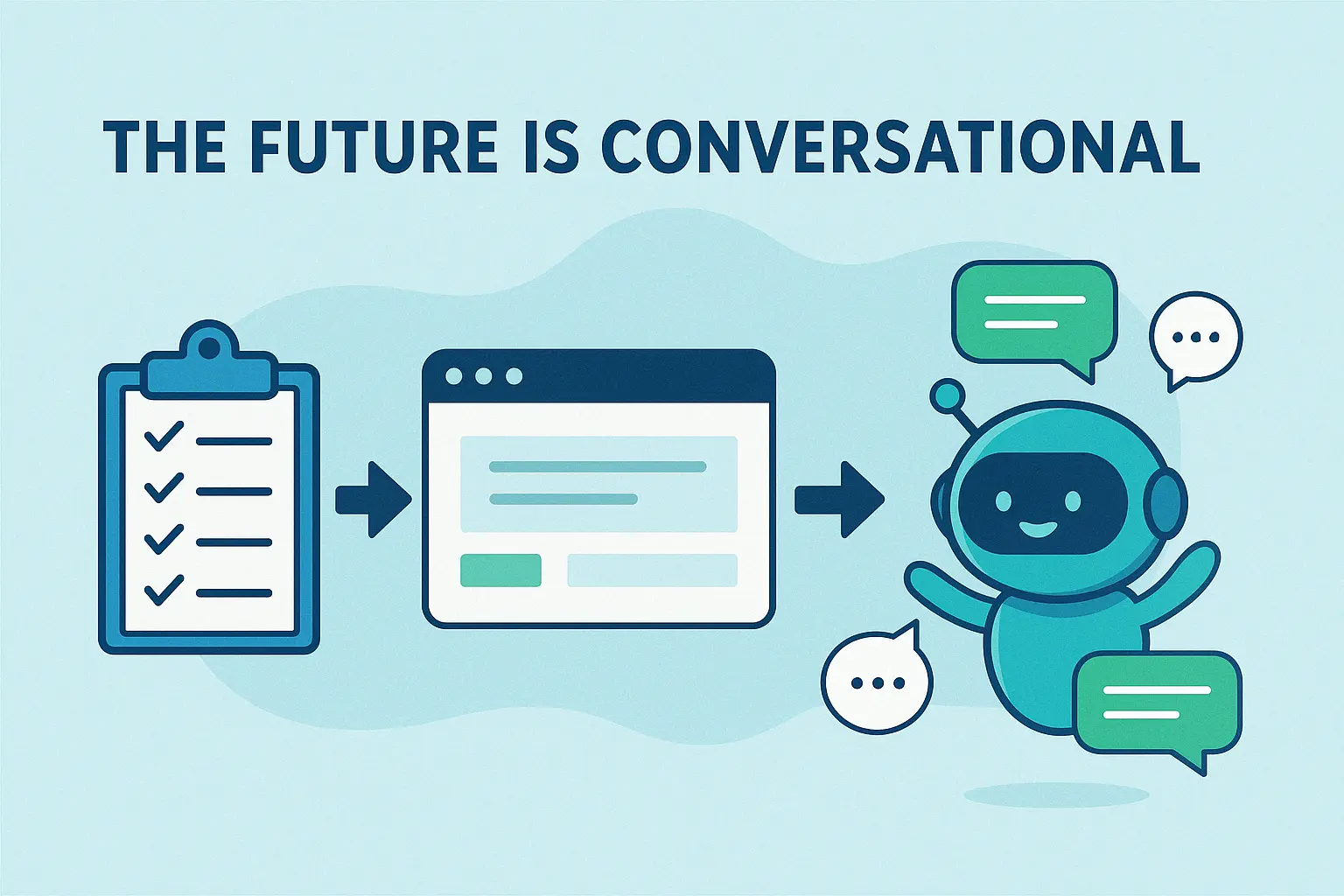
That moment — repeated across every unread contact form on every website in the world — is what conversational marketing is a reaction to. Not a tactic. Not a tool. A response to the fact that most website marketing is one-way, and buyers have stopped tolerating it.
I’ll define conversational marketing properly in a minute. But first, understand what it’s *not*.
It’s not just chatbots. Chatbots are one way of doing it — the most common way for small businesses, because they scale — but conversational marketing existed before chatbots and would exist without them.
It’s not just AI. AI made it cheaper to deliver, but “conversational” is the noun; the AI is optional infrastructure.
It’s a shift in how marketing gets done. Let’s start with what it actually is.
What conversational marketing actually is
Conversational marketing is a marketing approach that engages website visitors in real-time, two-way dialogue — typically through AI chatbots, live chat, or messaging apps — to answer questions, qualify leads, and capture contact details through conversation instead of static forms. Unlike traditional broadcast marketing, which sends one-way messages through ads, landing pages, and email and waits for a response, conversational marketing responds to each visitor’s specific interest in the moment.
In practice, it comes down to exchange rather than broadcast.
Broadcast is what most website marketing has always been: a landing page, an ad, an email, you put a message out, hope the right people see it, wait to see if they respond.
Exchange is different. Someone asks. You answer. They ask more. You answer more. Along the way, both sides learn whether it’s a fit, and by the time the conversation ends, either they’ve become a lead or they’ve cleanly disqualified themselves. No form. No wait.
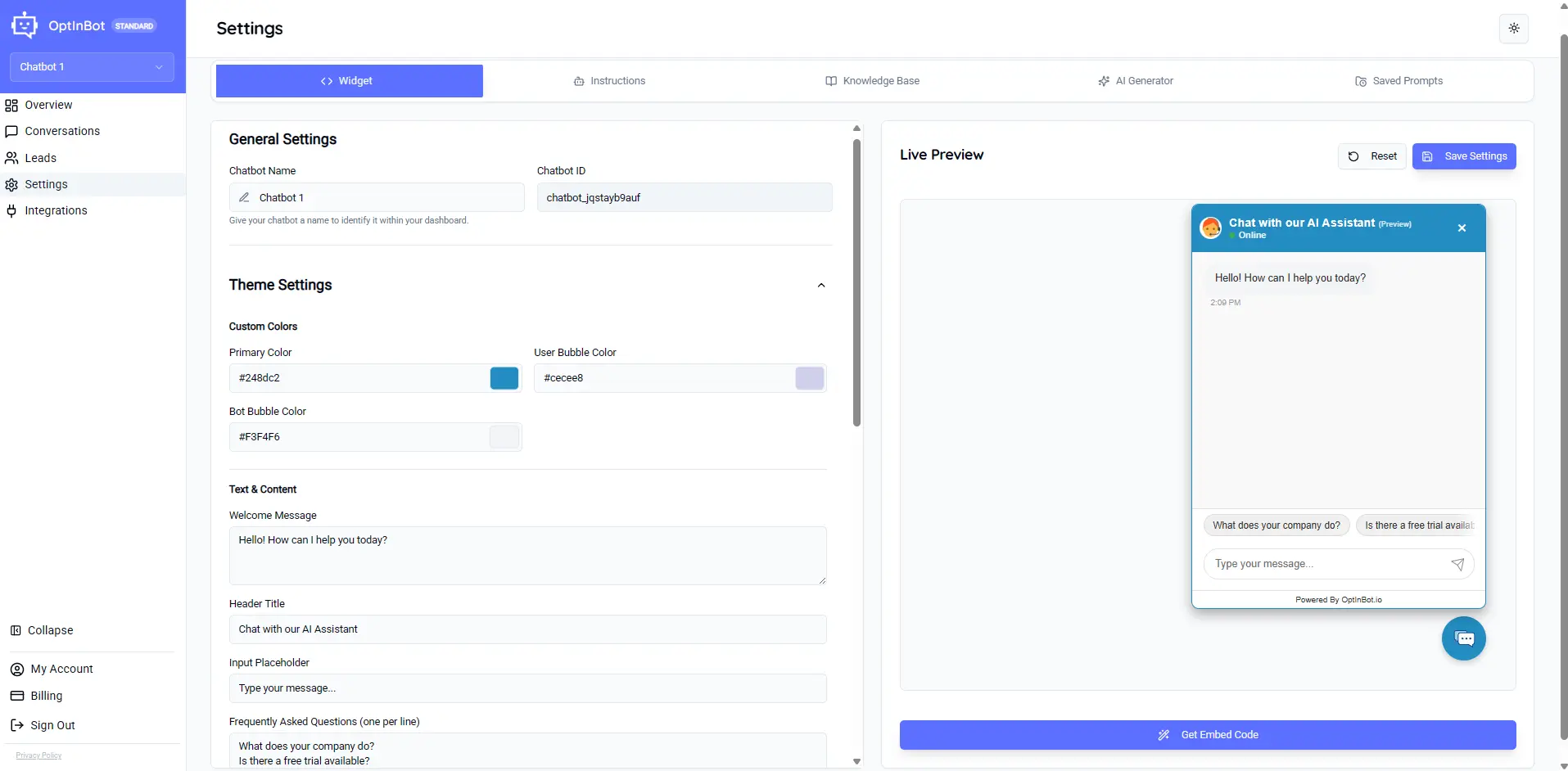
On a website, exchange usually means a chatbot in the corner: a small widget that greets visitors, answers their questions using knowledge about your business, and captures their contact info when the conversation has earned it.
You’ll see the same idea by other names, conversational lead capture, conversational lead generation, AI chat marketing. All variants of the same shift: dialogue over broadcast.
The point isn’t the label. The point is that when a visitor has a question and your marketing can answer it in real time, you sell more. When you can’t, you lose them.
For the full walkthrough on how a chatbot combines widget + knowledge + instructions to make this work, read the complete guide to conversational lead generation.
Why it’s changing how websites sell
If conversational marketing has been technically possible for a decade, why is it becoming the default *now*?
Three shifts happened at once.
Messaging apps trained everyone. WhatsApp, iMessage, Signal, Instagram DMs, for a decade, they trained billions of people to expect back-and-forth interaction with tap-to-answer speed. When you carry that expectation into a browsing session and land on a business website that only offers a form, the mismatch is jarring.
Mobile made writing feel expensive. Filling out a form on a phone is painful. Nobody wants to tap out a paragraph of what they need into a form field. But answering one chatbot question — one line, one tap — feels effortless.
AI made real-time answers cheap. For years, “conversational” meant hiring a human to sit on chat. Only enterprises could afford it. Now a bot can hold a real conversation, answer real questions, and cost less than a Netflix subscription. The economics finally work.
None of these alone were enough to change how businesses market. Together, they made conversational marketing not just possible but expected.
Think about how you contact a friend in 2026. You send a message. They reply. You reply. It happens in a rhythm — sometimes seconds apart, sometimes hours, but the shape is always the same: two people talking, in real time or near it, using words.
Now think about how the internet still expects you to contact most businesses.
You fill out a form. You wait for an email. You reply to the email. You wait again.
Nobody communicates like that anymore. Except businesses talking to their potential customers. That’s the gap conversational marketing closes — and that’s why the businesses that adopt it early are winning leads their competitors are losing to the tab-close.
What separates good conversational marketing from bad
Treats a chatbot as an instrument. What makes it work is the instructions someone wrote in plain English, the knowledge the bot draws on, and the timing of the ask.
Treats the chatbot as a channel. Adds the widget, calls it done, wonders why nothing changed.
Starts with one channel — usually the website — and gets it right before adding more. Tunes weekly based on real transcripts.
Launches on five channels at once — website chat, Messenger, WhatsApp, SMS, live chat. Calls it "multi-channel." It's noise.
Treats AI as infrastructure. A person reads transcripts weekly, rewrites instructions, fills knowledge gaps. Fifteen minutes a week.
Expects the AI to figure it out. Sets up the bot, feeds it the homepage, blames the tech when leads don't come.
Hands qualified leads to salespeople with the full transcript already attached. Sales closes with real context.
Tries to close inside the bot. Or has no one to hand off to. Leads land in a dashboard nobody checks.
What good conversational marketing looks like
The visitor lands on a bookkeeping firm’s services page. She’s evaluating three options. Hers is an S-Corp, she has a specific question about how they handle multi-state filings.
She clicks the chat widget. Types: “Do you handle S-Corp multi-state filings?”
Two seconds later, the bot: “Yes — we handle multi-state S-Corps regularly. Are you looking to switch, or is this your first time filing multi-state?”
She types: “Switching. Currently with a firm that doesn’t specialize in it.”
The bot: “Got it. To give you the most accurate quote, what state are you incorporated in, and how many states do you file in?”
She answers. The bot asks two more short questions. Then: “You look like a great fit for our S-Corp service tier. Want us to have a partner reach out with a specific quote? Just need your name and email.”
She provides both.
The partner gets an email notification with the full transcript already attached. He replies within an hour, referencing exactly what she said. She books a call two days later. Signs the following week.
That’s ninety seconds of visitor time. Zero form-fills. Full context handed to a human closer. She’d never have filled out a form.
That’s conversational marketing done right.
What made it work: the bot knew about S-Corps because someone uploaded the firm’s service pages and price sheet. The bot asked good qualifying questions because someone wrote good instructions. It timed the ask right — after she’d shown interest, before she left — because someone tuned it. It handed off to a real person because there was a person to hand off to.
Every one of those pieces required a decision by someone who cared. Not the AI. The person running it.
Conversational marketing done poorly looks like a chatbot that opens with “How can I help you today?” and asks for your email in the first message. Done poorly, it feels worse than a form.
Done well, it feels like a person on the other end who knew what they were doing. That’s what visitors respond to.
How to think about starting
Two ways to approach it, depending on what you have already.
If you don’t have a chatbot on your site yet: the first step isn’t picking a tool. It’s writing down five questions your prospects always ask before they buy — and the answers you always give. That’s the training data your future chatbot will use. Skip that step and no tool works.
Then pick a tool. Something priced for your size (small-business tools like OptinBot run $25/month for three chatbots; enterprise platforms bill $10K/year with annual contracts). Install it, load those five Q&As as training data, write a short instruction paragraph in plain English, put it live on one page. See what happens for a week.
If you already have a chatbot but it isn’t producing leads: the problem isn’t the tool. Read the transcripts. Every single one of them. You’ll see exactly what’s wrong within the first ten. Usually it’s one of three things — the greeting is generic, the bot asks for the email too early, or the knowledge base is stuffed with brand fluff instead of sales content. Fix whichever it is. Read transcripts again next week. Iterate. The tactical playbook for training a bot properly is in [how to train an AI chatbot to qualify leads without coding](/how-to-train-a-lead-generation-chatbot/).
Either way: don’t try to add multiple channels before the website version works. Don’t try to automate everything before you’ve read a conversation. Don’t buy the enterprise tool because someone in a demo told you it had “advanced NLP.”
The discipline is the point. The tool is downstream.