
Your bot’s live. Traffic is landing on it. Conversations are happening.
But leads aren’t coming through.
You check the dashboard. Ten conversations yesterday, zero captured leads. Same the day before. Something’s broken, but the bot is technically working.
The bot isn’t broken. It was trained wrong.
I’ve reviewed hundreds of underperforming lead capture chatbots. The same six mistakes show up over and over, and they’re all fixable in an afternoon, no coding required.
Here they are, in the order they hurt capture rate most.
Mistake 1 – Uploading brand guidelines instead of sales content
You fed the bot everything you could find in your Google Drive. Brand guidelines. Company handbook. Internal wiki articles. Your team’s messaging pillars document.
The bot dutifully read all of it. Now it talks like a brand consultant instead of a salesperson.
A visitor asks “what do you cost?” and the bot answers with three paragraphs about your “commitment to excellence” and your “customer-first values.” The visitor closes the tab.
Fix: strip the knowledge base. Delete anything internal. Delete anything about tone, values, or how the team works.
Keep only what a smart new hire would need on day one to close a sale:
— What you sell (services, products, packages)
— Who it’s for (ideal customers, common industries, disqualifiers)
— How much it costs (real pricing, real ranges)
— What makes you different from competitors
— What the buying process actually looks like
Rough rule: if you have to explain what the document is for, it doesn’t belong in the bot’s knowledge base.
Bots trained on operational content outperform bots trained on brand content by a factor most people wouldn’t believe until they see it.
Mistake 2 — Asking for contact info too early (or too late)
Timing is the single biggest lever in lead capture. Get it wrong in either direction and capture rate collapses.
Too early: the bot’s first message is “Hi! What’s your email?” The visitor didn’t come here to give you their email. They came to figure out if you’re worth talking to. Ask before you’ve earned it, and they bounce.
Too late: the bot answers eight questions, offers a free resource, and lets the visitor leave without ever asking. The visitor was interested. You never asked. They forgot about you by dinner.
The right moment: when the visitor has clearly decided you’re worth talking to.
Signals:
— They’ve asked about pricing or availability
— They’ve said “I’m interested” or “how do I get started?”
— They’ve asked a specific follow-up like “do you serve my area?”
Add this line to your bot’s instructions:
> When the visitor asks about pricing, availability, or how to get started, that’s your cue to ask for their name and email so someone from your team can follow up personally.
One line. Moves capture rate more than any other tweak.
The pattern: the bot’s job isn’t to interrogate. It’s to wait until the visitor is clearly ready, then ask.
Mistake 3 — Writing instructions that dictate the sequence instead of the outcome
This is the mistake that hides in plain sight. Your instructions probably look something like this:
> First, greet the visitor. Then ask what they’re looking for. Then ask about their budget. Then ask about their timeline. Then ask for their name and email.
The bot does exactly that. In order. Every visitor gets the same interrogation, no matter what they came in for. Three questions in, capture rate is dead.
The bot follows your instructions literally. If you write a sequence, it executes a sequence. That’s not a conversation, it’s a form with punctuation.
Fix: describe the outcome, not the steps.
> You are a helpful assistant for [Business Name]. Answer visitor questions naturally and help them understand what we do. When the conversation reaches a point where the visitor is clearly interested in working with us, ask for their name and email so we can follow up. Along the way, try to learn what they’re looking for, their timeline, and their location, but never more than one question at a time.
- First, greet the visitor.
- Then ask what they're looking for.
- Then ask about their budget.
- Then ask about their timeline.
- Then ask for their name and email.
- Answer visitor questions naturally.
- When the visitor is clearly interested, ask for their name and email.
- Along the way, try to learn what they need, their timeline, and their location.
- Never more than one question at a time.
The bot now picks the moment. Some visitors get asked in message two. Others get asked in message eight.
The bot reads the situation and adapts.
The rule: brief the bot the way you’d brief a junior salesperson on their first day, describe what a good outcome looks like, not the exact words to say in what order.
If you want the full step-by-step walkthrough, here’s the complete guide to training an AI chatbot to qualify leads. This post is what to avoid; that one is what to do.
Mistake 4 — A generic greeting that could apply to any business
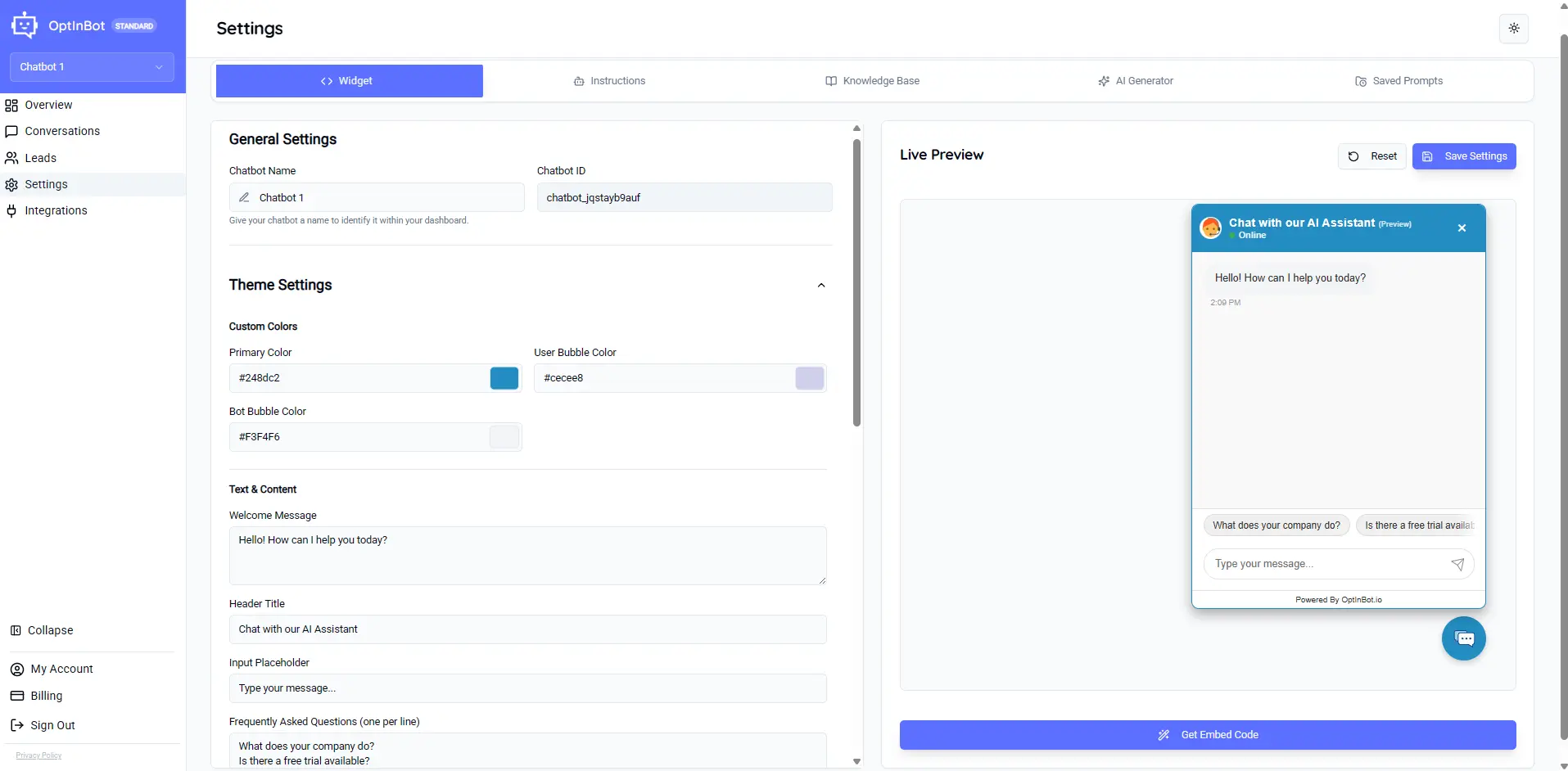
The default greeting on most bots is some variant of “Hi! How can I help you today?”
That message tells the visitor nothing. It could be a bank, a plumber, an insurance broker, or a SaaS tool. The visitor sees it and thinks: another generic bot, probably not worth my time.
Compare to something specific:
> Hi! Ask me anything about our bookkeeping services for small business owners.
Or:
> Hi, I’m here to help you figure out if we’re a good fit for your HVAC install project. What’s going on with your system?
The second version tells the visitor exactly what the bot is for AND filters out wrong-fit prospects in the same breath. Someone with a plumbing issue reads that greeting and moves on. Someone with an HVAC issue reads it and starts talking.
Fix: rewrite your greeting to include (1) what the business specifically does and (2) the kind of question the bot’s best at answering. If the greeting could apply to any business on any website, it’s too generic.
Small change. The move on capture rate is usually significant.
Mistake 5 — Never reading transcripts
You set the bot up. You wrote the instructions. You uploaded the docs. And then you never opened the dashboard again.
The bot is running. You have no idea what it’s actually saying.
Every underperforming bot I’ve seen has this in common: the person running it stopped reading transcripts. Or never started.
The transcripts are the tuning signal. They’re where you find:
— Questions the bot answered badly (fix: add a document or update instructions)
— Moments the bot asked for contact info too early (fix: adjust the trigger)
— Off-topic conversations that shouldn’t have started (fix: improve the greeting or add a disqualifier)
— Repeated visitor questions the bot handled well (turn these into FAQ content or LinkedIn posts)
— Moments visitors dropped mid-conversation (rewrite whatever the bot said last)
Fifteen minutes a week. That’s the whole loop.
Any bot you tune weekly for a month will outperform a bot that got set up perfectly on day one and never touched again. Every time.
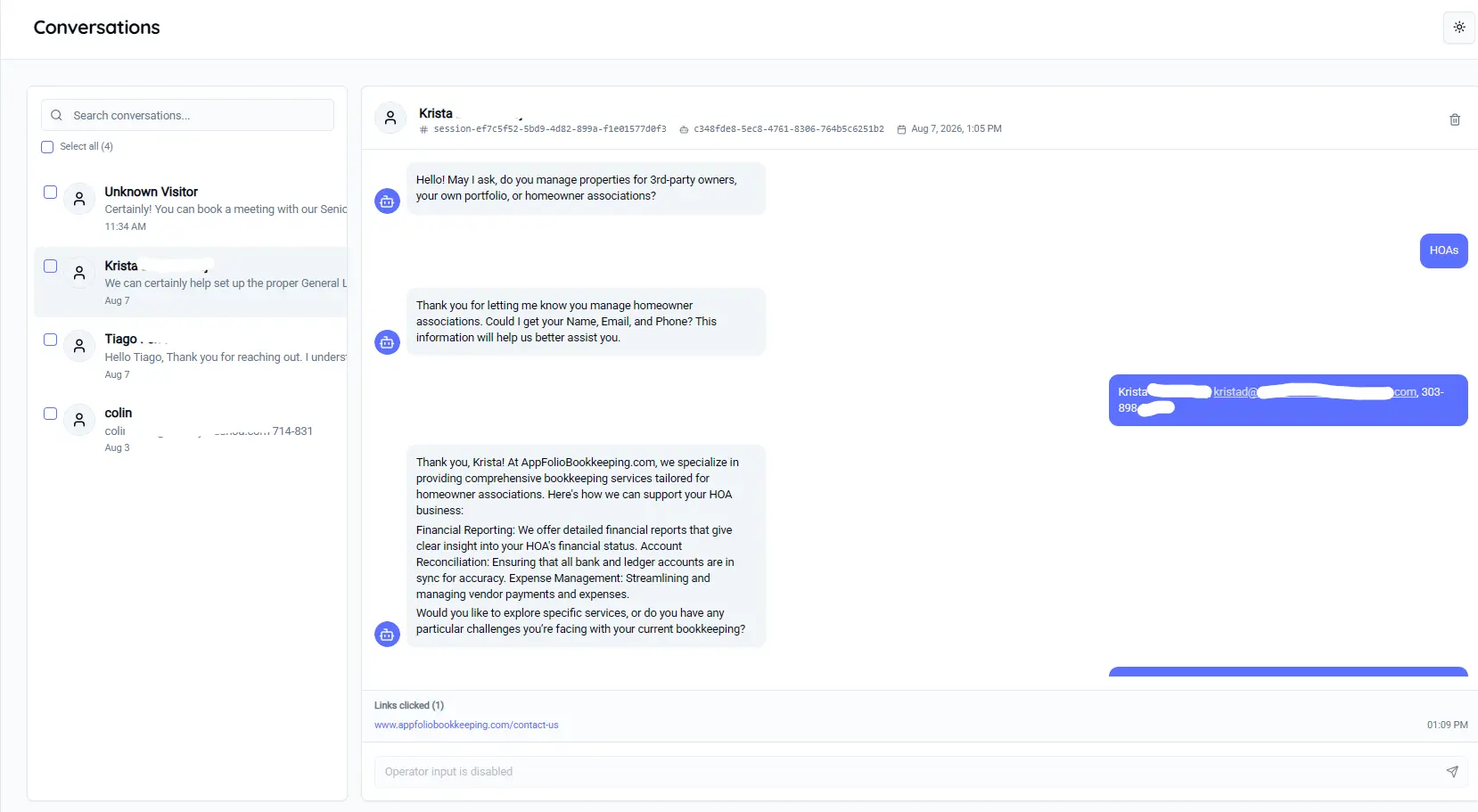
Conversations dashboard – OptInBot.io
Mistake 6 — Ignoring thumbs-down ratings
Every OptinBot conversation ends with a thumbs-up or thumbs-down prompt, plus an optional comment. Most operators glance at the ratings, feel good about the thumbs-ups, and never open the thumbs-downs.
The thumbs-downs are where the money is.
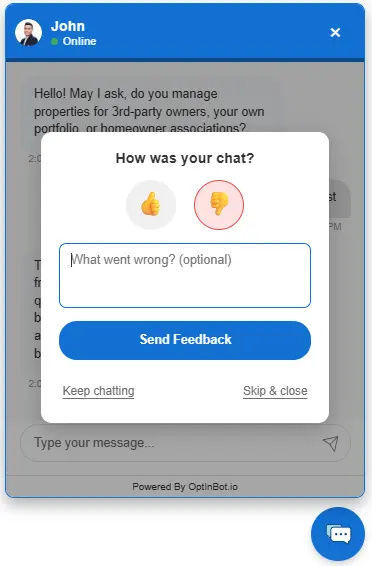
A thumbs-down means a real visitor got a bad experience and cared enough to flag it. That signal costs you nothing to collect and points directly at what’s broken. When you read the thumbs-down transcripts:
— You see the exact question the bot mishandled
— You see the language the visitor used (which usually reveals a knowledge gap or a bad instruction)
— You often see the phrasing that would have worked instead
Fix the specific instruction or add the specific document. Test the change with a similar phrasing. Move on.
Do this for a week and thumbs-down rate drops fast. Do it for a month and you’ve built a bot most competitors don’t have.
The mistake isn’t collecting bad ratings. It’s collecting them and never looking.
The pattern behind all six
Every mistake on this list traces back to the same root cause: treating the bot as a set-and-forget tool instead of a living asset.
The bots that convert best belong to operators who train them once, read what they said, and adjust. Weekly. Small changes, over time, on the specific things the transcripts and ratings point at.
The set-and-forget bots stay average forever.
Fifteen minutes a week is all it takes to move from average to real. Most people won’t do it. The ones who do build something that outperforms every competitor’s contact form — and every competitor’s set-and-forget bot.